

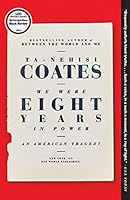
- Author: Ta-Nehisi Coates
- Full Title: We Were Eight Years in Power
- Tags: #Inbox #books
Highlights
- There is a basic assumption in this country, one black people are not immune to, which holds that if blacks comport themselves in a way that accords with middle-class values, if they are polite, educated, and virtuous, then all the fruits of America will be open to them. In its most vulgar form, this theory of personal Good Negro Government denies the existence of racism and white supremacy as meaningful forces in American life. In its more nuanced and reputable form, the theory pitches itself as an equal complement to anti-racism. But the argument made in much of this book is that Good Negro Government—personal and political—often augments the very white supremacy it seeks to combat. (Location 128)
- a strong belief in the singular will of black people, and a fixation on a supposedly glorious black past. (Location 389)
- the idea of the Great Fall—the theory, in this case, that post–Jim Crow blacks have lost touch with the cultural traditions that enabled them to persevere through centuries of oppression. (Location 395)
- social uplift. (Location 545)
- After all, chief among all individual rights awarded Americans is the right to be mediocre, crass, and juvenile—in other words, the right to be human. (Location 547)
- NOTES FROM THE SECOND YEAR (Location 563)
- In those days I imagined racism as a tumor that could be isolated and removed from the body of America, not as a pervasive system both native and essential to that body. From that perspective, it seemed possible that the success of one man really could alter history, or even end it. (Location 591)
- “You’re not really black,” they would say. They meant it as a compliment. But what they really meant was to slander her neighbors and family, to reorder the world in such a way that confirmed their status among the master class. (Location 605)
- By the summer of 2008, it was clear that I’d made an error. Two responses were possible: (1) Assess that error and reconsider the nature of the world in which I lived; or (2) refuse to accept the error and simply retrofit yesterday’s reasoning to this new reality. (Location 613)
- The notion that Obama was a “different kind of black” allowed for that latter option and the comfort of being right. (Location 615)
- We struggle to avoid our feelings, because to actually consider all that was taken, to understand that it was taken systemically, that the taking is essential to America and echoes down through the ages, could make you crazy. (Location 624)
- I did not want a good woman behind me, beside me, in front of me, or proximate to me in any of the old and maudlin ways. (Location 648)
- AMERICAN GIRL (Location 698)
- Bill Cosby once said, “African Americans (Location 723)
- But I did not understand blackness as a minority until I was an “only,” until I was a young man walking into rooms filled with people who did not look like me. In many ways, segregation protected me—to this day, I’ve never been called a nigger by a white person, and although I know that racism is part of why I define myself as black, I don’t feel that way, any more than I feel that the two oceans define me as American. (Location 816)
- But increasingly, as we move into the mainstream, black folks are taking a third road—being ourselves. Implicit in the notion of code-switching is a belief in the illegitimacy of blacks as Americans, as well as a disbelief in the ability of our white peers to understand us. But if you see black identity as you see southern identity, or Irish identity, or Italian identity—not as a separate trunk, but as a branch of the American tree, with roots in the broader experience—then you understand that the particulars of black culture are inseparable from the particulars of the country. (Location 837)
- If Barack and Michelle Obama are to truly transcend the racial divide, it won’t be through the narrative of justice, but through the mythology of the Great—and common—Cause. (Location 874)
- NOTES FROM THE THIRD YEAR (Location 889)
- To see this connection, to see Obama’s election as part of a familiar cycle, you would have had to understand how central the brand of white supremacy was to the country. (Location 923)
- “White men,” wrote Mississippi senator and eventual president of the Confederacy Jefferson Davis, “have an equality resulting from a presence of a lower caste, which cannot exist were white men to fill the position here occupied by the servile race.” Antebellum Georgia governor Joseph E. Brown made the same point: (Location 983)
- Enslavement provided not merely the foundation of white economic prosperity but the foundation of white social equality and thus the foundation of American democracy. (Location 992)
- WHY DO SO FEW BLACKS STUDY THE CIVIL WAR? (Location 1015)
- Its legacy belonged not to us, but to those who reveled in the costume and technology of a time when we were property. (Location 1038)
- that one group of Americans attempted to raise a country (Location 1042)
- In the popular mind, that demonstrable truth has been evaded in favor of a more comforting story of tragedy, failed compromise, and individual gallantry. For that more ennobling narrative, as for so much of American history, the fact of black people is a problem. (Location 1043)
- Davis claimed that Lincoln’s plan to limit slavery would make “property in slaves so insecure as to be comparatively worthless…thereby annihilating in effect property worth thousands of millions of dollars.” (Location 1054)
- the Confederacy was founded upon exactly the opposite idea…upon the great truth that the negro is not equal to the white man; that slavery, subordination to the superior race, is his natural and normal condition. (Location 1056)
- In such revisions of history lay the roots of the noble Lost Cause—the belief that the South didn’t lose, so much as it was simply overwhelmed by superior numbers; that General Robert E. Lee was a contemporary King Arthur; that slavery, to be sure a benevolent institution, was never central to the South’s true designs. (Location 1069)
- The celebrated Civil War historian Bruce Catton best sums up this sense when he refers to the war as “a consuming tragedy so costly that generations would pass before people could begin to say whether what it had bought was worth the price.” (Location 1116)
- In all regards, slavery was war on the black family. (Location 1124)
- The Civil War marks the first great defense of democracy and the modern West. (Location 1154)
- It is to understand what it means to live in a country that will never apologize for slavery, but will not stop apologizing for the Civil War. (Location 1161)
- White Americans finding easy comfort in nonviolence and the radical love of the civil rights movement must reckon with the unsettling fact that black people in this country achieved the rudiments of their freedom through the killing of whites. (Location 1187)
- The Civil War confers on us the most terrible burden of all—the burden of moving from protest to production, the burden of summoning our own departed hands, so that they, too, may leave a mark. (Location 1195)
- NOTES FROM THE FOURTH YEAR (Location 1200)
- And I feel it not just because of the black people swept away but because I know that “gentrification” is but a more pleasing name for white supremacy, is the interest on enslavement, the interest on Jim Crow, the interest on redlining, compounding across the years, and these new urbanites living off of that interest are, all of them, exulting in a crime. (Location 1211)
- White people are, in some profound way, trapped; it took generations to make them white, and it will take more to unmake them. (Location 1215)
- THE LEGACY OF MALCOLM X WHY HIS VISION LIVES ON IN BARACK OBAMA (Location 1300)
- The women belonged, as did I, to a particular tribe of America, one holding that we, as black people, were born to a country that hated us and that at all turns plotted our fall. A (Location 1324)
- Before Malcolm X, the very handle we now embrace—black—was an insult. We were coloreds or Negroes, and to call someone black was to invite a fistfight. But Malcolm remade the menace inherent in that name into something mystical—Black Power; Black Is Beautiful; It’s a black thing, you wouldn’t understand. (Location 1433)
- NOTES FROM THE FIFTH YEAR (Location 1504)
- Once I thought that there was something black in this, something about the streets. Then I learned that nations were atheists, which is to say they find their strength not in any God but in their guns. The code of the streets was the code of the world. The chrome .38 was a nuclear warhead—falsifying security, eroding humanity, and threatening all civilized existence. (Location 1518)
- Then I learned that nations were atheists, which is to say they find their strength not in any God but in their guns. (Location 1518)
- while the perpetrators of horrific evil backstroke through all the pleasures of the world. (Location 1522)
- I found, in this fixed and godless love, something cosmic and spiritual nonetheless. The fixed things gave me meaning: I was a black man dedicated to the improvement of myself and my black family, and that small story connected me to a community, living and dead. My (Location 1532)
- The world might fall off a cliff, but I did not have to be among those pushing it and more, I did not have to nod along while fools insisted that gravity was debatable. (Location 1559)
- A question—from other black writers and readers and a voice inside me now began to hover over my work—Why do white people like what I write? The question would eventually overshadow the work, or maybe it would just feel like it did. (Location 1644)
- FEAR OF A BLACK PRESIDENT (Location 1648)
- Despite his sloganeering for change and progress, Obama is a conservative revolutionary, and nowhere is his conservative character revealed more than in the very sphere where he holds singular gravity—race. (Location 1653)
- Obama is not simply America’s first black president—he is the first president who could credibly teach a black-studies class. He is fully versed in the works of Richard Wright and James Baldwin, Frederick Douglass and Malcolm X. Obama’s (Location 1668)
- The moment Obama spoke, the case of Trayvon Martin passed out of its national-mourning phase and lapsed into something darker and more familiar—racialized political fodder. (Location 1679)
- Racism is not merely a simplistic hatred. It is, more often, broad sympathy toward some and broader skepticism toward others. (Location 1719)
- “The thing is, a black man can’t be president in America, given the racial aversion and history that’s still out there,” Cornell Belcher, a pollster for Obama, told the journalist Gwen Ifill after the 2008 election. “However, (Location 1733)
- an extraordinary, gifted, and talented young man who happens to be black can be president.” Belcher’s formulation grants the power of anti-black racism, and proposes to defeat it by not acknowledging it. His is the perfect statement of the Obama era, a time marked by a revolution that must never announce itself, by a democracy that must never acknowledge the weight of race, even while being shaped by it. Barack Obama governs a nation enlightened enough to send an African American to the White House, but not enlightened enough to accept a black man as its president. (Location 1734)
- William F. Buckley Jr., who addressed the moral disgrace of segregation by endorsing disenfranchisement strictly based on skin color: (Location 1818)
- The sobering answer is Yes—the White community is so entitled because, for the time being, it is the advanced race. (Location 1822)
- Buckley, the founder of National Review, went on to assert, “The great majority of the Negroes of the South who do not vote do not care to vote and would not know for what to vote if they could.” (Location 1824)
- and found that in his first two years as president, Obama talked less about race than any other Democratic president since 1961. (Location 1895)
- This tradition stretches back to Frederick Douglass, who, in 1852, said of his native country, “There is not a nation on the earth guilty of practices more shocking and bloody than are the people of the United States at this very hour.” (Location 1913)
- Before Frederick Douglass worked, during the Civil War, for the preservation of the Union, he called for his country’s destruction. “I have no love for America,” he declaimed in a lecture to the American Anti-Slavery Society in 1847. “I have no patriotism….I desire to see [the government] overthrown as speedily as possible and its Constitution shivered in a thousand fragments.” (Location 1922)
- NOTES FROM THE SIXTH YEAR (Location 2094)
- In all of American life, there is a bias toward the happy ending, toward the notion that human resilience and intellect will be a match for any problem. This holds especially true for the problem of white supremacy. (Location 2096)
- But that was the job of the black public intellectual—not to stimulate, not to ask the questions that kept them up at night, not even just to interpret the drums but to interpret them in some way that promised redemption. This was not work for writers and scholars, who thrive in privacy and study, but performance-prophets who live for the roar of the crowd. (Location 2109)
- The promise of a cost-free escape from history should have made me suspicious. But what ultimately made me question the “rising tide” idea was not the theory itself but all the attendant theories that so often went with it. There (Location 2145)
- I had six siblings born to four women, two of them born in the same year, two of them born to friends. (Location 2154)
- It could have been true that unmarried black women were having the same number of children today as they had thirty years ago, but a drop in births to married women could still cause the percentage of out-of-wedlock births to increase. I called the Census Bureau and pulled as much data as I could on both categories. The birth rate for unmarried women had spiked in the late ’80s but was now declining and was at its lowest level since 1969, the furthest back I could trace census numbers. The early aughts saw a historic drop in teen pregnancy numbers, and much of that drop happened in the black community. It was a small thing to learn this, but it fixed my opposition to lazy cultural arguments. (Location 2165)
- so gullible as to be fooled by a prejudice that paid no dividends. (Location 2172)
- What if it was true that the masses of white Americans had not been fooled at all but that a critical mass of them had simply identified with a set of “interests” that were not purely economic and so powerful they overawed the class interests that liberals and leftists presumed should be broadly shared? (Location 2175)
- Ira Katznelson’s history of discrimination, When Affirmative Action Was White, which argued that similar exclusions applied to other “color-blind” New Deal programs, (Location 2190)
- a rising tide, too, could be made to discriminate. (Location 2192)
- The price black people paid was being forced out of the greatest government-backed wealth-building opportunity in the twentieth century. (Location 2193)
- generational wealth—the (Location 2206)
- generational debt—an (Location 2207)
- All the threads I had been working on in my blog and other work came together in “The Case for Reparations”: the critique of respectability politics, the realization that history could be denied but could not (Location 2214)
- be escaped, the understanding of the Civil War’s long shadow, the attempt to discover my own voice and language, and, finally, the deeply held belief that white supremacy was so foundational to this country that it would not be defeated in my lifetime, my child’s lifetime, or perhaps ever. (Location 2215)
- For Americans, the hardest part of paying reparations would not be the outlay of money. It would be acknowledging (Location 2224)
- that their most cherished myth was not real. (Location 2225)
- The essay has two problems that deserve to be acknowledged here. (Location 2226)
- THE CASE FOR REPARATIONS (Location 2257)
- I. “SO THAT’S JUST ONE OF MY LOSSES” (Location 2274)
- On the maps, green areas, rated “A,” indicated “in demand” neighborhoods that, as one appraiser put it, lacked “a single foreigner or Negro.” These neighborhoods were considered excellent prospects for insurance. (Location 2349)
- Contract sellers became rich. North Lawndale became a ghetto. (Location 2370)
- the league demanded “prayers for relief”—payback of all moneys paid on contracts and all moneys paid for structural improvement of properties, at 6 percent interest minus a “fair, non-discriminatory” rental price for time of occupation. Moreover, the league asked the court to adjudge that the defendants (Location 2391)
- In 1968, Clyde Ross and the Contract Buyers League were no longer simply seeking the protection of the law. They were seeking reparations. (Location 2398)
- II. “A DIFFERENCE OF KIND, NOT DEGREE” (Location 2399)
- had a rate more than forty times as high as the white neighborhood with the highest rate (Clearing). “This is a staggering differential, even for community-level comparisons,” Sampson writes. “A difference of kind, not degree.” (Location 2410)
- The kind of trenchant racism to which black people have persistently been subjected can never be defeated by making its victims more respectable. The essence of American racism is disrespect. And in the wake of the grim numbers, we see the grim inheritance. (Location 2440)
- III. “WE INHERIT OUR AMPLE PATRIMONY” (Location 2455)
- Quakers in New York, New England, and Baltimore went so far as to make “membership contingent upon compensating one’s former slaves.” (Location 2473)
- PLANTER: “You lazy nigger, I am losing a whole day’s labor by you.” FREEDMAN: “Massa, how many days’ labor have I lost by you?” (Location 2481)
- To proudly claim the veteran and disown the slaveholder is patriotism à la carte. (Location 2513)
- If Thomas Jefferson’s genius matters, then so does his taking of Sally Hemings’s body. If George Washington crossing the Delaware matters, so must his ruthless pursuit of the runagate Oney Judge. (Location 2515)
- Indeed, in America there is a strange and powerful belief that if you stab a black person ten times, the bleeding stops and the healing begins the moment the assailant drops the knife. (Location 2519)
- We inherit our ample patrimony with all its incumbrances; and are bound to pay the debts of our ancestors. This debt, particularly, we are bound to discharge: and, when the righteous Judge of the Universe comes to reckon with his servants, he will rigidly exact the payment at our hands. To give them liberty, and stop here, is to entail upon them a curse. (Location 2524)
- IV. “THE ILLS THAT SLAVERY FREES US FROM” (Location 2527)
- Twenty-five percent of interstate trades destroyed a first marriage and half of them destroyed a nuclear family. (Location 2572)
- Here we find the roots of American wealth and democracy—in the for-profit destruction of the most important asset available to any people, the family. The destruction was not incidental to America’s rise; (Location 2584)
- V. THE QUIET PLUNDER (Location 2591)
- Imagine what would happen if a president today came out in favor of taking all American homes from their owners: The reaction might well be violent. (Location 2597)
- “And looking upon African slavery from the same standpoint held by those noble framers of our Constitution, I for one have ever considered it one of the greatest blessings (both for themselves and us) that God ever bestowed upon a favored nation.” (Location 2600)
- in 1921 a white mob leveled Tulsa’s “Black Wall Street,” (Location 2613)
- When progressives wish to express their disappointment with Barack Obama, they point to the accomplishments of Franklin Roosevelt. But these progressives rarely note that Roosevelt’s New Deal, much like the democracy that produced it, rested on the foundation of Jim Crow. (Location 2617)
- As late as 1950, the National Association of Real Estate Boards’ code of ethics warned that “a Realtor should never be instrumental in introducing into a neighborhood…any race or nationality, or any individuals whose presence will clearly be detrimental to property values.” (Location 2644)
- Redlining was not officially outlawed until 1968, by the Fair Housing Act. By then the damage was done—and reports of redlining by banks have continued. (Location 2654)
- VI. MAKING THE SECOND GHETTO (Location 2660)
- In 1949, a group of Englewood Catholics formed block associations intended to “keep up the neighborhood.” Translation: Keep black people out. (Location 2680)
- Cook County grand jury declined to charge the rioters—and instead indicted the family’s NAACP attorney, the apartment’s white owner, and the owner’s attorney and rental agent, charging them with conspiring to lower property values. Two (Location 2689)
- they still had to contend with the hard facts of American housing policy: (Location 2696)
- When the mid-twentieth-century white homeowner claimed that the presence of a Bill and Daisy Myers decreased his property value, he was not merely engaging in racist dogma—he was accurately observing the impact of federal policy on market prices. Redlining destroyed the possibility of investment wherever black people lived. (Location 2696)
- bill,” Weatherspoon interjected. “You cut down on things for your child, that was the main thing,” said Lewis. “My oldest wanted to be an artist and my other wanted to be a dancer and my other wanted to take music.” (Location 2736)
- VIII. “NEGRO POVERTY IS NOT WHITE POVERTY” (Location 2744)
- Yet America was built on the preferential treatment of white people—395 years of it. Vaguely endorsing a cuddly, feel-good diversity does very little to redress this. (Location 2793)
- The Fair Housing Act might well be next. Affirmative action is on its last legs. In substituting a broad class struggle for an anti-racist struggle, progressives hope to assemble a coalition by changing the subject. (Location 2796)
- In the early years of the twentieth century, Mississippi Governor James K. Vardaman used to amuse himself by releasing black convicts into the surrounding wilderness and hunting them down with bloodhounds. (Location 2825)
- When we think of white supremacy, we picture COLORED ONLY signs, but we should picture pirate flags. (Location 2852)
- Reparations would mean the end of yelling “patriotism” while waving a Confederate flag. (Location 2872)
- X. “THERE WILL BE NO ‘REPARATIONS’ FROM GERMANY” (Location 2875)
- More important than any single check cut to any African American, the payment of reparations would represent America’s maturation out of the childhood myth of its innocence into a wisdom worthy of its founders. (Location 2940)
- “High levels of segregation create a natural market for subprime lending,” Rugh and Massey write, “and cause riskier mortgages, and thus foreclosures, to accumulate disproportionately in racially segregated cities’ minority neighborhoods.” (Location 2950)
- I aspired to join a long line of dream-breakers. If atheism is important to me, my sense of ancestry (Location 2991)
- The most important sentence in George Wallace’s “Segregation Now” speech is not the famous battle cry but the statement detailing on whose behalf the battle cry is made. It was not delivered simply on behalf of white Southerners but “the greatest people that have ever trod this earth.” (Location 3021)
- The governors who seek to tie the state’s willingness to pay for medical care to drug tests and work requirements are not pursuing a healthcare policy—they are awarding virtue and meaning to one group by warring upon another. (Location 3027)
- White supremacy is a crime and a lie, but it’s also a machine that generates meaning. This existential gift, as much as anything, is the source of its enormous, centuries-spanning power. (Location 3028)
- was excited about this story because I believed that “family” had been ceded to moral scolds who cared more about shaming people than actually helping families. (Location 3136)
- THE BLACK FAMILY IN THE AGE OF MASS INCARCERATION (Location 3148)
- In a word, most Negro youth are in danger of being caught up in the tangle of pathology that affects their world, and probably a majority are so entrapped. Many of those who escape do so for one generation only: as things now are, their children may have to run the gauntlet all over again. That is not the least vicious aspect of the world that white America has made for the Negro. (Location 3209)
- this, most of all, white America must accept responsibility,” Johnson said. Family breakdown “flows from centuries of oppression and persecution of the Negro man. It flows from the long years of degradation and discrimination, which have attacked his dignity and assaulted his ability to produce for his family.” (Location 3221)
- Moynihan’s aim in writing “The Negro Family” had been to muster support for an all-out government assault on the structural social problems that held black families down. (Location 3232)
- The United States now accounts for less than 5 percent of the world’s inhabitants—and about 25 percent of its incarcerated inhabitants. In 2000, one in 10 black males between the ages of (Location 3267)
- At a cost of $80 billion a year, American correctional facilities are a social-service program—providing health care, meals, and shelter for a whole class of people. (Location 3274)
- II. “WE ARE INCARCERATING TOO FEW CRIMINALS” (Location 3278)
- America’s closest to-scale competitor is Russia—and with an autocratic Vladimir Putin locking up about 450 people per 100,000, compared with our 700 or so, it isn’t much of a competition. (Location 3282)
- Among all black males born since the late 1970s, one in four went to prison by their midthirties; among (Location 3314)
- consequences for the economic viability of black families. Employment and poverty statistics traditionally omit the incarcerated from the official numbers. (Location 3317)
- The carceral state has, in effect, become a credentialing institution as significant as the military, public schools, or universities—but the credentialing that prison or jail offers is negative. (Location 3392)
- But the attitude that helps one survive in prison is almost the opposite of the kind needed to make it outside. (Location 3407)
- A tough veneer that precludes seeking help for personal problems, the generalized mistrust that comes from the fear of exploitation, and a tendency to strike out in response to minimal provocations are highly functional in many prison contexts but problematic virtually everywhere else. (Location 3410)
- One can imagine a separate world where the state would see these maladies through the lens of government education or public health programs. Instead it has decided to see them through the lens of criminal justice. As the number of prison beds has risen in this country, the number of public psychiatric hospital beds has fallen. (Location 3421)
- Antebellum Virginia had seventy-three crimes that could garner the death penalty for slaves—and only one for whites. (Location 3453)
- commonly called the Negro problem—lies in the correction of the immorality, crime, and laziness among the Negroes themselves, which still remains as a heritage from slavery.” Du Bois’s language anticipated the respectability politics of our own era. (Location 3487)
- Acquirement of the Drug Habit had concluded in 1902. The New York Times published an article by a physician saying that the South was threatened by “cocaine-crazed negroes,” to whom the drug had awarded expert marksmanship and an immunity to bullets “large enough to ‘kill any game in America.’ ” (Location 3498)
- “Twice as many inmates entered state correctional facilities in low-crime 1940 as in high-crime 1925,” Adler writes. At Angola State Penal Farm, the “white population rose by 39 percent while the African American inmate population increased by 143 percent.” (Location 3553)
- The principal source of the intensifying war on crime was white anxiety about social control. (Location 3555)
- V. THE “BADDEST GENERATION ANY SOCIETY HAS EVER KNOWN” (Location 3561)
- As incarceration rates rose and prison terms became longer, the idea of rehabilitation was mostly abandoned in favor of incapacitation. (Location 3593)
- Before reform, prisoners typically served 40 to 70 percent of their sentences. After reform, they served 87 to 100 percent of their sentences. (Location 3597)
- “There is nothing more painful to me at this stage in my life than to walk down the street and hear footsteps and start thinking about robbery, then look around and see somebody white and feel relieved,” he was speaking to the very real fear of violent crime that dogs black communities. The argument that high crime is the predictable result of a series of oppressive racist policies does not render the victims of those policies bulletproof. Likewise, noting that fear of crime is well grounded does not make that fear a solid foundation for public policy. (Location 3632)
- Between 1983 and 1997, the number of African Americans admitted to prison for drug offenses increased more than twenty-six-fold, relative to a sevenfold increase for whites….By 2001, there were more than twice as many African Americans as whites in state prison for drug offenses. (Location 3639)
- To reiterate an important point: Surveys have concluded that blacks and whites use drugs at roughly the same rates. And yet by the close of the twentieth century, prison was a more common experience for young black (Location 3643)
- Biden cast Democrats as the true party without mercy. (Location 3650)
- “Let me define the liberal wing of the Democratic Party,” he said in 1994. “The liberal wing of the Democratic Party is now for 60 new death penalties….The liberal wing of the Democratic Party has 70 enhanced penalties….The liberal wing of the Democratic Party is for 100,000 cops. The liberal wing of the Democratic Party is for 125,000 new state prison cells.” (Location 3650)
- In 1993, Texas rejected a bid to infuse its schools with $750 million—but approved $1 billion to build more prisons. (Location 3654)
- Under the avowedly liberal Cuomo, New York added more prison beds than under all his predecessors combined. (Location 3659)
- penal welfarism (Location 3660)
- VI. “IT’S LIKE I’M IN PRISON WITH HIM” (Location 3681)
- For starters, the family must contend with the financial expense of having a loved one incarcerated. Odell’s parents took out a second mortgage to pay for their son’s lawyers, and then a third. (Location 3717)
- VII. “OUR VALUE SYSTEM BECAME SURVIVING VERSUS LIVING” (Location 3771)
- Instead, taken together, they constitute what Sampson calls “compounded deprivation”—entire families, entire neighborhoods, deprived in myriad ways, must navigate, all at once, a tangle of interrelated and reinforcing perils. (Location 3791)
- In a recent study, Sampson and a co-author looked at two types of deprivation—being individually poor, and living in a poor neighborhood. Unsurprisingly, they found that blacks tend to be individually poor and to live in poor neighborhoods. But even blacks who are not themselves individually poor are more likely to live in poor neighborhoods than whites and Latinos who are individually poor. (Location 3793)
- This world was the product of oppression—but it was a world beloved by the people who lived there. It is a matter of some irony that the time period and the communities Taylor was describing with fond nostalgia are the same ones that so alarmed Daniel Patrick Moynihan in 1965. Taylor (Location 3819)
- Incarceration pushes you out of the job market. Incarceration disqualifies you from feeding your family with food stamps. Incarceration allows for housing discrimination based on a criminal background check. Incarceration increases your risk of homelessness. Incarceration increases your chances of being incarcerated again. (Location 3850)
- “The prison boom is not the main cause of inequality between blacks and whites in America, but it did foreclose upward mobility and deflate hopes for racial equality.” If generational peril is the (Location 3854)
- “The Negro Family” is a flawed work in part because it is a fundamentally sexist document that promotes the importance not just of family but of patriarchy, arguing that black men should be empowered at the expense of black women. (Location 3876)
- One does not build a safety net for a race of predators. One builds a cage. (Location 3903)
- they believed that Americans were capable of taking in critiques of black culture and white racism at once. But this underestimated the weight of the country’s history. (Location 3912)
- For African Americans, unfreedom is the historical norm. Enslavement lasted for nearly 250 years. The 150 years that followed have encompassed debt peonage, (Location 3914)
- convict lease-labor, and mass incarceration—a period that overlapped with Jim Crow. (Location 3915)
- In 1900, the black-white incarceration disparity in the North was seven to one—roughly the same disparity that exists today on a national scale.*25 (Location 3926)
- IX. “NOW COMES THE PROPOSITION THAT THE NEGRO IS ENTITLED TO DAMAGES” (Location 3928)
- As we enter the 2016 presidential-election cycle, candidates on both sides of the partisan divide are echoing Bush’s call. From the Democratic Socialist Bernie Sanders (“To my mind, it makes eminently more sense to invest in jobs and education, rather than jails and incarceration”) to mainstream progressives like Hillary Clinton (“Without the mass incarceration that we currently practice, millions fewer people would be living in poverty”) to right-wing Tea Party candidates like Ted Cruz (“Harsh mandatory minimum sentences for nonviolent drug crimes have contributed to prison overpopulation and are both unfair and ineffective”), there is now broad agreement that the sprawling carceral state must be dismantled. (Location 3935)
- In 1972, the U.S. incarceration rate was 161 per 100,000—slightly higher than the English and Welsh incarceration rate today (148 per 100,000). To return to that 1972 level, America would have to cut its prison and jail population by some 80 percent. (Location 3943)
- There is no reason to assume that a smaller correctional system inevitably means a more equitable correctional system. (Location 3964)
- Changing criminal-justice policy did very little to change the fact that blacks committed crimes at a higher rate than whites in Minnesota. (Location 3967)
- The lesson of Minnesota is that the chasm in incarceration rates is deeply tied to the socioeconomic chasm between black and white America. (Location 3972)
- The two are self-reinforcing—impoverished black people are more likely to end up in prison, and that experience breeds impoverishment. (Location 3973)
- This, too, is self-reinforcing. The American population most discriminated against is also its most incarcerated—and the incarceration of so many African Americans, the mark of criminality, justifies everything they endure after. (Location 3976)
- His point was simple, if impolitic: Blacks were suffering from the effects of centuries of ill treatment at the hands of white society. Ending that ill treatment would not be enough; the country would have to make amends for it. (Location 3987)
- “It may be that without unequal treatment in the immediate future there is no way for [African Americans] to achieve anything like equal status in the long run,” Moynihan wrote. (Location 3988)
- Robert Sampson argues for “affirmative action for neighborhoods”—reform that would target investment in both persistently poor neighborhoods and the poor individuals living in those neighborhoods. One class of people suffers deprivation at levels above and beyond the rest of the country—the same group that so disproportionately (Location 3999)
- fills our jails and prisons. To pull too energetically on one thread is to tug at the entire tapestry. (Location 4001)
- NOTES FROM THE EIGHTH YEAR (Location 4121)
- lack of both ceilings and safety nets is how we got a black president. I suspect it is how, at least for these eight years, I came to thrive. I had started (Location 4144)
- True, a writer’s opinions and subjectivity are always in the work—even for novelists and poets—but I think I prefer to have them in the background, operating as subtext. There’s something inherently beautiful about a story, in its ability to make more powerful arguments than an explicit polemic. (Location 4185)
- And I don’t ever want to forget that resistance must be its own reward, since resistance, at least within the life span of the resistors, almost always fails. (Location 4188)
- MY PRESIDENT WAS BLACK (Location 4197)
- I. “LOVE WILL MAKE YOU DO WRONG” (Location 4203)
- “There are no more,” the comedian Sinbad joked back in 2010. “There are no black men raised in Kansas and Hawaii. That’s the last one. Y’all better treat this one right. The next one gonna be from Cleveland. He gonna wear a perm. Then you gonna see what it’s really like.” (Location 4263)
- II. (Location 4294)
- HE WALKED ON ICE BUT NEVER FELL (Location 4294)
- But Obama appealed to a belief in innocence—in particular a white innocence—that ascribed the country’s historical errors more to misunderstanding and the work of a small cabal than to any deliberate (Location 4318)
- To reinforce the majoritarian dream, the nightmare endured by the minority is erased. (Location 4361)
- III. “I DECIDED TO BECOME PART OF THAT WORLD” (Location 4390)
- Assessing his own thought process at the time, Obama writes, “I decided to become part of that world.” This is one of the most incredible sentences ever written in the long, decorated history of black memoir, if only because very few black people have ever enjoyed enough power to write it. (Location 4409)
- ‘Ain’t it a bitch to be a black man in the land of the free and the home of the brave?’ (Location 4473)
- What proved key for Barack Obama was not that he was born to a black man and a white woman, but that his white family approved of the union, and approved of the child who came from it. They (Location 4514)
- did this in 1961—a time when sex between black men and white women, in large swaths of the country, was not just illegal but fraught with mortal danger. (Location 4516)
- world than most blacks of the 1960s had. Obama told me he rarely had “the working assumption of discrimination, the working assumption that white people would not treat me right or give me an opportunity or judge me [other than] on the basis of merit.” (Location 4526)
- What Obama was able to offer white America is something very few African Americans could—trust. (Location 4550)
- IV. “YOU STILL GOTTA GO BACK TO THE HOOD” (Location 4556)
- If black men were overrepresented among drug dealers and absentee dads of the world, it was directly related to their being underrepresented among the Bernie Madoffs and Kenneth Lays of the world. (Location 4617)
- White households, on average, hold seven times as much wealth as black households—a difference so large as to make comparing the “black middle class” and “white middle class” meaningless; they’re simply not comparable. According (Location 4625)
- pigmentocracy—one (Location 4629)
- I asked him whether it wasn’t—despite the practical obstacles—worth arguing that the state has a collective responsibility not only for its achievements but for its sins. (Location 4643)
- “So in part, I think the argument sometimes that I’ve had with folks who are much more interested in sort of race-specific programs is less an argument about what is practically achievable and sometimes maybe more an argument of ‘We want society to see what’s happened and internalize it and answer it in demonstrable ways.’ And those impulses I very much understand—but my hope would be that as we’re moving through the world right now, we’re able to get that psychological or emotional peace by seeing very concretely our kids doing better and being more hopeful and having greater opportunities.” (Location 4692)
- V. “THEY RODE THE TIGER” (Location 4720)
- The Republican Party is not simply (Location 4737)
- the party of whites, but the preferred party of whites who identify their interest as defending the historical privileges of whiteness. (Location 4738)
- The researchers Josh Pasek, Jon A. Krosnick, and Trevor Tompson found that in 2012, 32 percent of Democrats held antiblack views, while 79 percent of Republicans did. (Location 4738)
- “They abort their young children, they put their young men in jail, because they never learned how to pick cotton,” Bundy explained. “And I’ve often wondered, are they (Location 4812)
- better off as slaves, picking cotton and having a family life and doing things, or are they better off under government subsidy? They didn’t get no more freedom. They got less freedom.” (Location 4813)
- “Whites are less likely to be drawn to the Tea Party for material reasons, suggesting that, relative to other groups, it’s really more about social prestige,” they (Location 4828)
- 2016, he won election to the presidency. Historians will spend the next century analyzing how a country with such allegedly grand democratic traditions was, so swiftly and so easily, brought to the brink of fascism. (Location 4838)
- VI. “WHEN YOU LEFT, YOU TOOK ALL OF ME WITH YOU” (Location 4842)
- Imagine an African American facsimile of Hillary Clinton: She would never be the nominee of a major political party and likely would not be in national politics at all. (Location 4900)
- EPILOGUE THE FIRST WHITE PRESIDENT (Location 4949)
- It is insufficient to state the obvious of Donald Trump: that he is a white man who would not be president were it not for this fact. (Location 4957)
- It is often said that Trump has no real ideology, which is not true—his ideology is white supremacy in all of its truculent and sanctimonious power. Trump inaugurated his campaign by casting himself as the defender of white maidenhood against Mexican “rapists,” only to be later revealed as a proud violator. (Location 4973)
- power. In this, Trump is not singular. But whereas his forebears carried whiteness like an ancestral talisman, Trump cracked the glowing amulet open, releasing its eldritch energies. (Location 4985)
- Trump truly is something new—the first president whose entire political existence hinges on the fact of a black president. And so it will not suffice to say Trump is a white man like all the others who rose to become president. He must be called by his correct name and rightful honorific—America’s first white president. (Location 5001)
- Ostensibly assaulted by campus protests, battered by theories of intersectionality, throttled by bathroom rights, a blameless white working class did the only thing any reasonable polity might: elect an orcish reality television star who insists on taking his intelligence briefings in picture-book form. (Location 5019)
- But the researchers also found that voters in their study who supported Trump generally had higher mean household incomes ($81,898) than those who did not ($77,046). Those who approved of Trump were “less likely to be unemployed and less likely to be employed part-time” than those who did not. They also tended to be from areas that were very white: (Location 5025)
- racial and ethnic isolation of whites at the zip code level is one of the strongest predictors of Trump support.” (Location 5027)
- Every demographic group, that is, except one: voters who identified as white. (Location 5047)
- Trump is pawned off as a product of the white working class as opposed to a product of an entire whiteness that includes the very authors doing the pawning. The motive is clear: escapism. (Location 5049)
- This is by design. Senator and celebrated statesman John C. Calhoun saw slavery as the explicit foundation for a democratic union among whites, working or not: With us the two great divisions of society are not the rich and poor, but white and black; and all the former, the poor as well as the rich belong to the upper class, and are respected and treated as equals. (Location 5098)